Torchiere Wall Sconces
Torchiere Wall Sconces and Uplight Wall Lighting
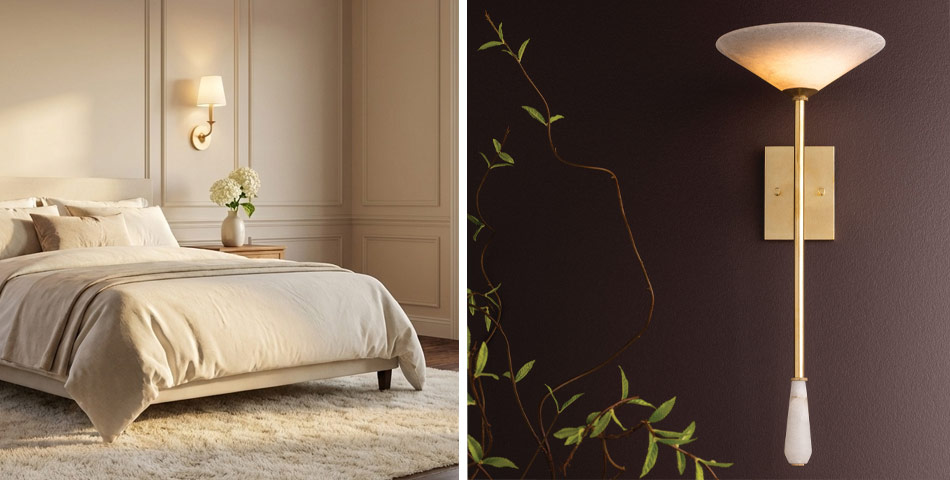
Torchiere wall sconces direct light upward, using the wall and ceiling as part of the lighting effect. Inspired by the classic torchiere form, these wall-mounted fixtures can provide indirect ambient illumination while adding a decorative or architectural element to the room.
Lightology's assortment extends well beyond a single aesthetic, with streamlined metal sconces, glass designs, shaded fixtures, decorative silhouettes, and more sculptural interpretations. The collection also spans a broad range of brands and styles, making torchiere sconces relevant to contemporary, transitional, and more traditional interiors.
What Is a Torchiere Wall Sconce?
A torchiere wall sconce is generally characterized by an upward-facing light source or shade. Rather than directing most of its illumination downward, the fixture sends light toward the ceiling or upper wall, where it can contribute to the room's ambient lighting.
The category includes many interpretations of this basic idea. Some sconces resemble a traditional torch with a pronounced shade or diffuser at the top, while others abstract the form through glass, metal, elongated profiles, or integrated lighting. The direction and intensity of the light ultimately depend on the individual fixture.
Why Choose an Uplight Wall Sconce?
Uplight wall sconces are useful when softer, indirect illumination is preferred to a more concentrated beam. Light directed toward surrounding surfaces can contribute to the overall brightness of a room while keeping the fixture itself mounted neatly against the wall.
They can also emphasize vertical architecture. The relationship between the fixture, illuminated wall, and ceiling can draw attention upward, making torchiere sconces useful for spaces where lighting is intended to contribute to both the atmosphere and the architecture.
Where to Use Torchiere Sconces
Torchiere wall sconces work particularly well in living rooms, dining rooms, hallways, entryways, bedrooms, and other areas that benefit from layered ambient lighting. A pair can establish symmetry around a fireplace, doorway, console, or architectural feature, while a series of sconces can create rhythm along a hallway or larger wall.
Consider how much illumination the room already receives from ceiling fixtures, pendants, lamps, and natural light. A torchiere sconce may serve primarily as atmospheric lighting in one space and contribute more significantly to general illumination in another, depending on its output and light distribution.
Using Torchiere Sconces for Layered Lighting
Wall-mounted uplighting can complement rather than replace other light sources. Pairing torchiere sconces with chandeliers, pendants, recessed lighting, floor lamps, or table lamps creates multiple levels of illumination and gives a room greater flexibility.
This approach is particularly useful in living and dining spaces, where lighting needs can change throughout the day. Dimming can provide additional control when available, but dimming method and compatibility vary by fixture and light source, so review the individual specifications before selecting controls.
Choosing the Right Size and Projection
Scale is especially important with wall lighting because the fixture is viewed in direct relationship to nearby furniture, doors, artwork, and architectural details. Consider the sconce's height, width, projection from the wall, and visual weight rather than relying on height alone.
Projection deserves particular attention in hallways and other circulation areas. A shallow fixture can occupy less physical space, while more dimensional torchieres may use projecting arms, shades, or sculptural forms as part of their design. Check individual dimensions and applicable project requirements when clearance is a concern.
Glass, Metal, Shades, and Decorative Materials
Material has a significant effect on both the appearance of a torchiere sconce and the way its light is perceived. Clear, etched, seeded, opal, and other types of glass can interact with the light differently, while opaque metal shades may create a more distinctly directed uplight. The current assortment also includes fixtures with fabric shades and other decorative materials.
Finish can help determine whether the fixture recedes into the architecture or becomes a stronger decorative accent. Black and darker finishes can create graphic contrast, while brass, bronze, nickel, and related metallic finishes can reinforce details elsewhere in the room.
Light Sources, Brightness, and Dimming
Torchiere wall sconces are available with different light-source configurations, including fixtures that use replaceable bulbs as well as integrated LED designs. Integrated LED can support especially compact or sculptural forms, but it is not a defining requirement of the category. For example, Lightology's Delphi Torchiere Wall Sconce uses an integrated LED module, while the broader assortment includes many other fixture constructions.
When comparing options, review lumen output, color temperature, CRI, light-source requirements, and dimming compatibility where those specifications are provided. These factors can be more useful than wattage alone when determining how a particular sconce will contribute to the room.
Torchiere Sconces for Hallways and Circulation Areas
Wall sconces can provide useful ambient light in hallways, stair areas, and passageways without occupying floor or furniture space. Torchiere forms add another dimension by directing illumination upward, which can visually connect the walls and ceiling while maintaining a clear path through the space.
Pay close attention to fixture projection, mounting location, and applicable clearance requirements in circulation areas. A fixture's inclusion in the torchiere category does not indicate that it is ADA compliant, and compliance depends on the specific fixture, installation, mounting height, location, and project requirements.
Shop Torchiere Wall Sconces at Lightology
Explore torchiere wall sconces at Lightology for living rooms, dining rooms, bedrooms, hallways, entryways, and other spaces where upward-facing wall lighting can contribute to a layered lighting plan. The collection includes decorative torch-style sconces, streamlined uplights, glass and metal designs, shaded fixtures, and contemporary interpretations with a wide variety of proportions, finishes, and light sources.












 (312) 944-1000
 215 W. Chicago Avenue, Chicago, IL 60654